


Role: giles corey
01
The beginning
The Crucible by Arthur Miller is a dramatic retelling of the Salem witch trials of 1692, exploring how fear, power, and mass hysteria can dismantle truth and justice. Written as an allegory for McCarthyism in the 1950s, the play examines how reputations are weaponized and how silence can become complicity. In this production, the story’s moral tension was heightened through a stripped, atmospheric staging that emphasized the fragility of integrity within a rigid and oppressive society. At its core, the play asks what it costs to stand firm in one’s convictions when the world demands submission.
For the ticket design, I chose to expand on a card motif I had previously explored, this time adapting it into a tarot-inspired aesthetic to align with the supernatural fear and moral symbolism of The Crucible. Tarot imagery, often associated with fate, judgment, and hidden truths, felt thematically connected to the paranoia and accusations within the play. Each ticket was designed as if it were a tarot card drawn from a prophetic deck, symbolizing the inevitability and doom looming over Salem.
I utilized stark contrasts, aged textures, and symbolic framing to evoke a sense of mysticism and foreboding. The typography was carefully selected to feel period-inspired while remaining legible, and the composition centered around iconography that suggested judgment, fire, or scales of justice. By continuing the card motif, I created visual continuity within my body of design work while adapting it to suit a darker and more mature narrative. This process reinforced the importance of cohesion across artistic disciplines; the tickets were not merely functional objects but extensions of the production’s thematic world. Through this design, I learned how visual symbolism can prepare an audience psychologically before the performance even begins.
02
The middle
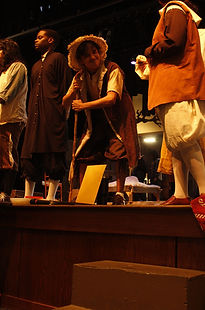
Portraying Giles Corey required me to balance strength, age, humor, and moral conviction within a single character arc. Rather than playing him as simply the eccentric old farmer, I focused on his underlying courage and loyalty — particularly his devotion to truth and to his wife. I approached Giles as a man who speaks before he thinks, yet whose impulsiveness comes from a deeply rooted sense of justice. Physically, I grounded my performance with a heavier gait and deliberate, weighted movements to suggest a lifetime of labor. I widened my stance and kept my chest open to reflect his stubborn resolve, while allowing moments of stillness to signal the gravity of the court’s corruption. Vocally, I adopted a roughened, forceful tone with sharp consonants to express his frustration with the absurdity of the trials.
As the play progressed and the hysteria intensified, I shifted from outward energy to internalized resistance. Instead of meeting chaos with equal volume, I leaned into controlled stillness and intentional pauses, allowing the weight of Giles’ defiance to resonate without overstatement. His refusal to yield — especially in the face of authority — became less about anger and more about dignity. Through this role, I learned how restraint can be more powerful than intensity, and how conviction on stage must come from grounded emotional truth rather than performance alone. Giles taught me that courage in theatre, as in life, often lies in unwavering presence.


03


The End
In addition to portraying Giles Corey, I composed and arranged original and sacred music to deepen the emotional and spiritual atmosphere of The Crucible. I arranged Illumina Oculos Meos, traditionally attributed to Thomas Tallis, selecting it for its haunting plea: “Enlighten my eyes.” The text resonates powerfully within the world of Salem, where characters claim divine authority while remaining spiritually blind to their own corruption. I approached the arrangement with restraint and intention, emphasizing sustained dissonances, open fifths, and layered harmonies to create a sense of unresolved tension. Rather than allowing the music to dominate, I designed it to function as an emotional undercurrent — swelling beneath transitions and dissolving into silence at moments of moral weight. The goal was not spectacle, but atmosphere.
In addition to this arrangement, I composed an original setting of Psalm 100, which provided a contrasting yet thematically relevant spiritual dimension to the production. Psalm 100 is traditionally associated with praise and joyful devotion, and I intentionally shaped my composition to feel reverent but restrained — reflecting how faith in Salem exists within rigid structure and social pressure. I explored modal harmonies and steady rhythmic patterns to evoke a sense of communal worship, while subtly incorporating harmonic shifts that introduced unease beneath the surface. This contrast between praise and paranoia mirrored the tension of the play: a society outwardly devoted to God yet internally fractured by fear.
Composing and arranging for this production strengthened my understanding of how music shapes theatrical storytelling. I learned how tonal color, dynamic pacing, and silence influence audience psychology. More importantly, I discovered how sacred text and historical context can be used intentionally to reinforce dramatic themes. Through this work, I expanded beyond performance and into authorship — contributing not just interpretation, but original artistic voice to the production.


